Tuesday, September 11, 2007

Correlation vs. Causation


` In science, there are two basic types of studies; correlational and experimental. One is to determine that two or more factors are related; the other is to figure out how.

` In a correlational study, scientists are basically trying to find patterns, often by comparing two or more very similar things - ideally with only one very important difference.
` An example would be looking at the medical histories of two groups of people in which the only important difference is that one smokes cigarettes and the other doesn't. Doing this has shown that smoking is associated with a high risk of developing certain health problems including poor circulation, emphysema, heart disease and cancer.
` You have to be careful here, however, because even though it's a sensible proposition, correlation in itself does not imply causation! It is true that, for instance, drowning rates increase whenever ice cream sales go up. But does buying ice cream cause drowning - or conversely, does drowning cause people to buy ice cream?
` The cause you're looking for, of course, is called 'summer' - one factor causes both results!

` So, how do we know that cigarettes are bad for us? That's what an experimental study is for!

` Experiments not only study correlation but actually cause the difference between the study groups. So, if we were to do an experiment on seeing if smoking can cause these health problems in human beings, we would have to round up a bunch of similar individuals and randomly divide them into two groups.
` One group would be forced to take up smoking, while the other would be kept from smoking at all. But, since that's unethical and practically impossible, scientists keep a most wretched tool around the lab; the domesticated rat.
` Let's say the scientists have a group of rats from one genetic strain, all living in the same type of cage and eating the same food. Basically, what the scientists need to do is make some of the rats breathe in cigarette smoke while making sure the rest don't.
` When the rats forced to breathe in smoke start developing health problems similar to the ones found in human smokers, it now becomes clearer that cigarette smoke is a major cause of the same kinds of disorders in both humans and rats!
` Sure, it's not one hundred percent certain that cigarettes are also a significant cause of these types of lung problems, etc. in humans - because we have not performed that experiment on our own species - but we can be reasonably sure it's legitimate.

` The great thing about science is that a) there are few things that are reasonably 100% certain (like the rising of the sun as Mercury mentioned, not to mention the law of gravity or the existence of molecules) and b) there are plenty of scientists with opposing viewpoints - and evidence to back them up - so therefore there is much discussion and speculation about various possible causes of events.
` At any one time, the general consensus among scientists for a given phenomenon is the best they know. New information is being added all the time, of course, and if someone has figured out something that really works better, then that becomes the new 'best'.
` This doesn't mean that knowledge derived from science is unreliable in itself; just that there is often more than meets the eye that is waiting to be discovered. While this usually puts a new spin on previous knowledge, it sometimes can completely invalidate a hypothesis.

` Take the case of a University of Pennsylvania Medical Center study that positively linked the presence of night-lights in young children's bedrooms with their development of nearsightedness. (A tentative idea to begin with.) However, a later study by the Ohio State University found that parents who were nearsighted were most likely to have nearsighted children - and that they were more likely to put night-lights in their children's bedrooms!
` In this case, the University of Pennsylvania's conclusion - as well as the massive amounts of media attention it received - seems a bit... well, myopic, as it now would seem that the vision problems of nearsighted parents are the common cause of both correlates.

` This is one thing that, indeed, scientists know well: Though one thing may appear to cause another thing, without clear enough evidence one must always suspect alternatives. You never know what new realizations the next batch of data will bring!


Read more!

Sunday, September 9, 2007

Context and the 9/11 Conspiracies - Part 2


` Picking up from where I left off last time, I believe I was going on about how to make a conspiracy theory, and I exposed some of the claims made by the 9/11 conspiracy theorists concerning the destroyed buildings and the planes that crashed into them.

` On this post, I will cover a few other topics (though I will probably add more in the future).


The Other Plane

` The other hijacked plane had been headed for Washington - until the passengers overtook the hijackers and crashed it into an unoccupied area. How does anyone know this if there was no radio contact? Cell phone contact with passengers and the plane's black box made it all too clear.
` If you're a conspiracy theorist, you'll be actively looking for the scantiest evidence of a half-truth in order to support your view that the official story is wrong.
` It is no wonder that the creators of Loose Change attended the premiere of the movie, United 93, and to - as one forum member put it - "bite these bastards where it hurts, and have this Flight 93 movie backfire on them."[Quote.]

` There are two different ways you can go with this conspiracy theory, depending on what set of 'evidence' you want to go with.

` To the conspiracy theorists, there have been two outcomes of Flight 93, depending on who you ask. Some of them say that the plane landed safely, which stems from the initial AP reports saying that Flights 1989 and 93.
` Indeed, air traffic controllers at first believed 1989 had been hijacked. However, none of them claimed that 93 landed.
` It was the 'allegedly hijacked' Flight 1989 that landed in Cleveland Hopkins Airport and not 93; the AP did correct the error later on. [Kropko, M.R. 2002. " September 11 Tension Vivid to Controller ." Associated Press, August 15, 2002.]
` Though the plane (with its victims) was shredded - like many similar plane crashes - much of it has been recovered, and 1500 bits of human remains were found and identified as those who had been on board.

` The other conspiracy theory was that the plane had been shot down by the U.S. military. Since the flight data controller did not record any unusual functional readings (vibrations, air pressure changes, fuel intake, etc.) before the time of the crash, this does not seem likely.
` Some claim that the last few minutes of the flight controller recording was missing or being covered up - in fact, this is due to the plane simply having impacted shortly before they said it did.
` The conspiracy theorists also asserted that the main body of the engine and other large chunks were found scattered over several miles. Actually, we know that the engine was found 300 yards away, no doubt about it, and it was in a position that was consistent with the direction the plane had been moving. [" 9/11: Debunking the Myths ." Popular Mechanics. March, 2005.]
` The black box, also found, clearly records the struggle that had been going on before the crash.

` With errant planes on the loose, one might think that the other planes might have been shot down by the government - especially if they were capable of shooting down the one. However, NORAD did not have the capability of locating nor intercepting those planes.
` Taken into account all the planes that have needed to be shot down over the years, there have been only 67 other interceptions in history before September 11, 2001. Why?
` First off, the NORAD personnel have to radio contact the planes to rule out mundane problems, and then they must contact military personnel to scramble planes after them.
` The 9/11 case was actually much harder than usual because the terrorists had turned off or disabled the plane's radar transponders. Therefore, it would have looked like a moving blip among many others on NORAD's screens, making it impossible for them to even locate and intercept them in the short window of time available.

` According to the Popular Mechanics article:
In the decade before 9/11, NORAD intercepted only one civilian plane over North America: golfer Payne Stewart's Learjet, in October 1999. With passengers and crew unconscious from cabin decompression, the plane lost radio contact but remained in transponder contact until it crashed. Even so, it took an F-16 1 hour and 22 minutes to reach the stricken jet. Rules in effect back then, and on 9/11, prohibited supersonic flight on intercepts. [" 9/11: Debunking the Myths." Popular Mechanics. March, 2005.]

Other Silly Allegations

` Another conspiracy theorist 'puzzle piece' is that there was a lot of 'put' trading of airline stock, which is a huge gamble. They surmise that the 'insiders' knew what would happen, and so placed their bets.
` Now consider that this is a common event and that the general volume of put trading had also reached the same levels just earlier in the year. Plus, general bad news about the airline industry directly prompted investment companies to tell their clients that put options would be the best course of action.
` There was in fact a large spike in American Airlines trade, though this is hardly surprising: the company had just released a major warning because they had expected possible stock losses. ["AMR Corp Issues 3Q' 2001 Profit Warning." Airline Industry Information, September 11, 2001, " Plummeting Profit." Zeal Speculation and Investment. June 22, 2001.]
` So, what's the point in finding another way to explain it? Is that not sufficient?

` The conspiracy theorists also claim that FEMA arrived at the WTC on September 10, 2001 because they knew that the disaster was about to happen.
` This allegation was based on a statement by Tom Kenney of the Massachusetts task force to Dan Rather on Sept 13, 2001: "We're currently, uh, one of the first teams that was deployed to support the city of New York for this disaster. We arrived on, uh, late Monday night and went into action on Tuesday morning. And not until today did we get a full opportunity to work, uh, the entire site." [Schorow, Stephanie. 2002. " Independent Research." Boston Herald. 5 September (Arts & Life).]
` That seems a bit strange, considering that Monday was September 10. What seems to have happened there was that Kenney confused which day was which - something that commonly happens to people who are working for two long days in emergency response.
` What he apparently meant to say was that he arrived at Ground Zero on the eleventh, which he must have thought was Monday but was really Tuesday, and went into action on 9/12, and did not get a chance to work the whole site until 'today' or, 9/13. In addition, many different sources have documented the arrival of FEMA on 9/11, including Kenney's wife. [Schorow, Stephanie. 2002. " Independent Research." Boston Herald . 5 September (Arts & Life).]

` I could go on, though I hope that through these examples it becomes clear that the Truth Movement is not so much concerned with the truth as they are concerned with grossly distorting it.

The Ones They Refuse to Blame

` It should be noted that the Conspiracy theorists are curiously silent about al Qaeda, radical Islamic terrorists from Pakistan, or any of our recent history with the Middle East.
` Do they know about the fall of the Ottoman empire? Do they know about the fragmentation that occurred after WWII? Or the reaction of Muslims to the state of Israel, plus all the frustration about America's support for it? Do they know what Islamic fundamentalism is, or what Soviet Russia has to do with anything?

` The reasons why there are Islamic terrorist groups stem from all of that, and such people have been targeting and attacking America for decades:

` For example, in 1983 Hezbollah truck-bombed a Marine barracks in Lebanon , killing 241 Americans. In 1985, the Palestinian Liberation Front hijacked the Achille Lauro. In 1993, the WTC was bombed via truck , killing six people and injuring a thousand others (ironically, the memorial was destroyed in the 9/11 attack ).
` In January, 1995, thanks to funding by terrorists such as the head of Al-Qaeda (Osama bin-Laden),
there was a plan to blow up twelve planes between the U.S. and Asia, though it was stopped.
` In 1995,
bin-Laden had the U.S. Embassy buildings in Kenya and Tanzania bombed , killing twelve Americans, and 200 natives. In 1996, terrorists truck-bombed the Khobar Towers , killing nineteen U.S. military personnel and injuring hundreds more. In 1999, Ahmed Ressam became famous for his attempted attack on Los Angeles international airport.
` On October 12, 2000, Al-Qaeda arranged
a successful suicide boat bombing of the U.S.S. Cole, killing seventeen sailors and injuring 39 more. [Strasser, Steven (ed.). 2004. The 9/11 Investigations: Staff Reports of the 9/11 Commission . New York: Public Affairs Books. More about radical Islam at Rashid, Ahmed. 2001. Taliban: Militant Islam, Oil and Fundamentalism in Central Asia. New York: Yale University Press.]

` Clearly, Osama Bin Laden has been funding, organizing, and initiating such shenanigans against the U.S., and there is plenty of evidence to back that up. He has also issued two fatwas - one in 1996 declaring a jihad against the U.S. and one in 1998 "to kill the Americans and their allies — civilian and military is an individual duty for any Muslim who can do it in any country in which it is possible to do it."
[Strasser, Steven (ed.). 2004. The 9/11 Investigations: Staff Reports of the 9/11 Commission . New York: Public Affairs Books, and other sources.]
` Not only is there every reason in the world to think that this was their work, bin-Laden and Al-Qaeda have actually admitted to the September 11 bombings! [Bamer, David. 2001. "Bin Laden: Yes, I Did It." The Telegraph. November 11.] What would be the point of saying that they were not responsible?
` To all scrutiny, this is but the latest, and worst, attack on us by radical Islamic terrorists because they don't want our 'evil' U.S. foreign policy, along with everything else. Unfortunately, we didn't take them seriously, and so it was American civilians who paid the price.

` ...But how many people actually
know about this stuff? The truth is, so many do not that it seems a bit odd when someone does know their history. Therefore, such conspiracy theories are perhaps believable to more people than they could be.
` A more emotional reason why some people like conspiracy theories - in general - is because they are able to keep their eye on what they believe to be dangerous, and so they know who to expect danger
from! (Curiously, such people who supposedly believe that the U.S. is a 'police state', are interviewed on national television and radio and hold Truth Conventions in public without fear of being arrested!)
` Realistically, the real truth is what is most important to implement in the future, because
only the truth can be used to prevent future terrorist attacks - and no, I don't think the 'War on Terror' has done anything of the sort.


Read more!

Wednesday, September 5, 2007

How much brain do we really need?


` Have you ever wondered that? A month ago, I was reading the Nature News item The man with a hole in his brain. (Free to non-paying members here.)
` I've always thought the myth that we only use ten percent of our brains was amusing. In fact, all parts of the human brain are active all the time; just enough to keep our neurons from dying, at least.
` However, at any given time, some parts of the brain are more active than others - for instance there are parts on the left side of the brain that contribute to different facets of language, and the entire occipital lobe (in the back of your head) is devoted to various aspects of visual processing.
` Astonishingly, there have been some normally-functioning people who have been said to have only ten percent of a brain! ...However, this is apparently an exaggeration. Nevertheless, the people I am referring to were hydrocephalics with large holes in their brains studied by such doctors as John Lorber, a former professor of pediatrics at Sheffield University.

` Hydrocephalus is a potentially serious condition where more cerebrospinal fluid flows into one's ventricles than out, resulting in a ballooning of pressure within the brain. The force is so enormous that it can squash the brain against the braincase and expand the as-yet unfused skull of an infant.
` Aside from causing seizures, convulsions and mental retardation, this condition can also be fatal if a shunt is not installed to allow the fluid to drain into other parts of the body. In several notable cases, however, such squashed brains have functioned almost normally!

` The Nature article talks of a case study made three years ago of man in Marseille, France. He had a wife, kids, an IQ of 75, and he worked as a civil servant. Three years ago, this man went to a hospital, informing staff of a weakened left leg.
` That was his only real complaint. Searching for neurological abnormalities, they found his brain wadded up into a thin layer to make room for the ventricles that took up most of the room in his braincase.
` "We were very surprised when we looked for the first time the CT scan," commented Neurologist Lionel Feuillet. "The brain was very, very much smaller than normal."

` I'll say. See for yourself!

` This man had probably been born with hydrocephalus. He had been given a shunt at six months of age, and had it fixed at 14 years when he had problems with his left leg. At 44 years old, this most recent complaint was the first time he had experienced neurological problems since then.
` How his brain had managed to develop normally currently escapes neurologists, but that doesn't mean it's impossible to explain:
` The pattern of the most prevalent difficulties in hydrocephalics (focusing and coordination) suggests that the areas immediately surrounding the ventricles are affected the most. If the brain retains a relatively normal structure during this stretching (despite damage), those would be the most-stretched areas.
` Importantly, the brain is able to re-route areas of functioning from damaged areas while it is developing; perhaps the pressure caused most of the brain deformation during development in the Marsielle man's case.

` It is hard to say just how his brain had developed; CT scanners were not around when he was having problems earlier in life. As for the his treatment outcome this time around, the fluid had been shunted once more, and his brain remained the same size.
` Who knows if we'll ever know. Perhaps he'll be kind enough to donate his brain to science when he's done using it?


Read more!

Tuesday, August 14, 2007

Who's afraid of Carl Sagan?


Last updated August 18.

` By gum I've been busy: Finals are growing closer and yet I have been spending almost all of my waking moments hydrating and grooming my unwell kitten (and protecting her from my well kitten). [Note: She has recovered by now.]
` Since it's about time I updated again, I thought I would present for you some musings related to the philosophy of science. This time it has to do with a book by the late Carl Sagan called The Demon Haunted World, which I'm reading at the moment. (Or trying to!)

` A while back, I was looking at some reader reviews on Amazon.com about this book, and I noted that most of them were overall positive - even glowing - though there were a few which back up the general observation that his message does not seem to reach those who feel it threatens their very identity.
` So what is his message, and why? The beauty here is that I don't really have to say much because the reviewers have already done such a good job of that. (Thanks, everyone, my brain needed the rest!)
` I think William H. Fuller put the 'what' and the 'why' rather succinctly:

Sagan's definition of the scientific method of thought is marvelous. Such thought must be totally open, allowing all ideas to enter for consideration, denying admission to none.
However, once those ideas have entered, they must be subjected to the utmost skepticism, for only those that can withstand the examination of the skeptic, the doubter, the unbeliever, may be accepted into residency, and even that is not guaranteed for perpetuity, for, as new facts are discovered, what was once held to be true may no longer be so.

Do we need yet more justification to read Sagan's book? May I offer a few statistics from page 324?
"Sixty-three percent of American adults are unaware that the last dinosaur died before the first human arose; 75 percent do not know that antibiotics kill bacteria but not viruses; 57 percent do not know that `electrons are smaller than atoms.' Polls show that something like half of American adults do not know that the Earth goes around the Sun and takes a year to do it. I can find ... students who do not know that the ... Sun is a star."
You know, many years ago, I was asked by one of my own students if I was "prejudiced," and I shocked the entire classroom when I answered, "Yes." I went on to explain that my prejudice was not against a race or a gender but against refusal to learn, against the illusive comfort of ignorance.
Judging by the statistics quoted by Sagan, I still have a lot in this country to be prejudiced against. Do these statistics support Sagan's argument for better scientific education in America? Personally, I'd say that they do.
` I second that. As Sagan points out, much of our lives (including economy, medicine, transportation, environmental protection, even entertainment) rely on science, and yet not very many presidents of the United States have even had a very good grasp of what that is.

` So who are these people who fear the scientific method so much? As far as I know, they are generally people who believe they know what the scientific method is despite the fact that they actually don't (at least, not very well).
` This gives them the feeling that they are an authority on the subject, so there's no getting the point across to them that they aren't. Not only that, but many of them are extremely volatile and instead of being articulate and using logic skills in their arguments, they try to see just how offensive they can possibly be.
` (As a physics forum manager, my Worthy Science Sources sponsor has found much the same thing. This is why I do not accept such comments on this blog.)
` Why are they so hostile? Perhaps this whole 'I'm right about what I think science is' business is something they feel is the very essence of their being. So, if you challenge them, you threaten them in the most personal way.

` Assuming this is a somewhat widespread phenomenon, it may well account for the fact that the internet is rife with such reactions to skepticism/science.

` This reader review is entitled 'What an idiot!' by Violent A, made on April 25, 2007. I think the title sums it up, and it's a typical example of this type of 'anything goes' commentary.
Wow... just wow, this dude has no F-ing clue what he's talking about. Was he even trying? If this is the best skeptics can do to promote their ignorant, hypocritical view of what they consider science vs. pseudoscience, then that is all the more reason to believe in the paranormal!

This book is so pathetically devoid of information, the arguments within are so hypocritical when not illogical and baseless, I feel sorry for him if he is actually as stupid as he sounds in this book.

If I had met him I'd be glum just like the driver guy he describes in the beginning of the book, whose belief in ancient civilization like Atlantis and Lemuria he glibly dismisses due to lack of scientific evidence. That degree of brainlessness -he can't even grasp the difference between history and science!!- is depressing. I wouldn't know what to say; "No words... they should have sent... a poet..."
` Might I point out that history is also a science? Historians are skeptics; they don't just leap to conclusions. They are very careful about accepting things as true. That's why they suspend beliefs about Atlantis - just where the story comes from and what it is based on is not for certain, so it's open to interpretation.
` So were is Violent A's anger coming from, you ask? I think this statement makes it clear:
If you want to be an informed person, if you want a real candle in the dark, read works by Laura Knight-Jadczyk and David Icke.
` If that doesn't, then perhaps this response by Q-fever will:
You're joking, right? Icke and Knight-Jadczyk are mentally ill. They believe that the world is controlled by reptilian space aliens or some such nonsense. Knight-Jadczyk talks to reptilian space aliens on a ouija board!
I happen to know that the reptilains are actually subservient to an even greater race of half butterfly-half monkey super-aliens that have secret camps throughout the Brazilain rainforest (although they're originally from Neptune,i think). Anyways, you had me going there for a second, violentA.
` I can guess that this is why ViolentA is so... violent. (At least verbally.) When you've been fed this type of 'information' about skepticism, you view the words of scientists/skeptics as being totally dismissive, contradictory, uneducated and ignorant. When you integrate this belief into the very core concept of your being, you feel a strong urge to defend it ferociously.
` I know this because I used to be the same way, though I wasn't into believing that our world leaders are humanoid iguanas in disguise. I once felt threatened by the words of people like Carl Sagan. I would rant to myself; "What a bunch of closed-minded morons! And they're running science?"

Q: Well, what did I know about it?
A: Absolutely nothing. But I thought I knew a lot more than practically everyone, even scientists themselves!

` From a teenaged me, a book like Sagan's would have been greeted with retorts like, "I can't believe he thinks this skepticism stuff comes anywhere close to being spiritual!" and "He either doesn't know anything about science, or he's lying to everyone!" ...that is, if I could even be coaxed to read it.
` Never in my wildest dreams would I have come to realize that skepticism/the scientific method is only all about being cautious. You have to make sure you realize you're in a dead-end because it's usually overwhelmingly simple and easy to make major mistakes.
` The scientific method is all about anticipating, avoiding and finding such mistakes in any research so that we can build up our knowledge of the world as accurately as possible. Pseudoscience, on the other hand, is unlike science precisely because many or most of its mistakes are typically ignored, downplayed or covered up.

` However, I would have argued with this idea vigorously, because the fact that they disagreed with the 'sensible, open-minded' people whose preachings I believed were careful enough to qualify as scientific themselves, pretty much 'proved' that there was some kind of conspiracy against 'us'.
` Also, while I could believe that the most brilliant minds in science were being deceived (either that or lying), I did not stop to think that perhaps I - a complete know-nothing about the scientific method - could be the one being deceived!

` But I wasn't a know-nothing, I thought! I was one of those who saw through the delusion!

` Far from conspiring against who I believed to be valiant defenders of 'alternative science', dedicated scientists are constantly under attack from each other. The battles are not pretty, and the death rate of hypotheses is staggering.
` So, if you feel threatened by the prospect that you could be wrong about something you hold dear, or perhaps insecure in general, scientific debates and negotiations are probably not for you. A scientist must be comfortable enough to admit that nature (or people) can fool them!

` I noticed that one Amazon reviewer responded to an earlier review that had been removed from the website. I wonder what that person had written. Whatever it was, this response was precisely the type of thing that a) I needed to hear when I was younger and b) would have gotten angry at if someone actually expected me to believe it:
Some people see skeptisim as form of close-mindedness, and the writer of the review from June 14 "Science hmm" exemplifies that type of person.
Obviously anyone can tell that person is speaking without any basis, and its a very funny post, but also the reason why this book needs to be read (I'm sure that person, if he even read Sagan's book at all, did it with ingrained preconceived notions of the "evils of science")
This guy claims all of science is narrow minded and fascist (haha) but even many who aren't completely off their rocker, think skepticism is bad.
The skeptic mindset is to only [consider] facts at face value, and only believe when sufficient evidence is provided. This is the only way to promote a rational mindset. Those who think skeptics are narrow minded truely don't understand its purpose.
` No they don't. I certainly did not. You couldn't convince me, and I would have certainly laughed at anyone who said skepticism/science was a device that promotes open-mindedness.
` I was very glad to believe what I believed because I really thought that skeptics/mainstream scientists were completely brainwashed. If someone had told me I'd agree with them one day, I would have been horrified and perhaps would have wanted to kill myself just to avoid this outcome.
` These are the strong feelings that the most vehement anti-skeptics probably feel. Of course they're not going to listen! But I don't expect that most people, even believers in pseudoscience, are like this. Perhaps most can admit that scientists aren't as dismissive as they may have been taught.
` Like Naturopathic ND, many readers were surprised at this fact:
...I did not find Sagan to be as close minded and negative on this topic as I expected, he is open to new age ideas as long as they can validate themselves.
` While the book covers mostly paranormal topics, it does touch on religion here and there. However, one reader did find many quotes that compared religion to pseudosciences, and pointed out that this must indicate that Sagan was 'secretly anti-religious' and thought that all religious people must be a bunch of unreasonable extremists.
` As I had begun reading the book, however, I stumbled upon a paragraph that explains those statements:
In certain passages of this book I will be critical of the excesses of theology, because at the extremes it is difficult to distinguish pseudoscience from rigid, doctrinaire religion.
` Then he goes on to say that religion itself has fought these excesses, which has resulted in such groups as protestants and liberals.
` The '3D Artsit/ Brandi' "Brandi" is evidently one of the extremists, however. She left a comment called: 'to bad--Your Lost---This book is clueless':
What can I say,
The Devil is preety good at covering stuff up. He uses even the best Scientist and astronomers to crush anything spiritual.

Of coarse this book is garbage and I suggest that everyone who likes this book to please take yourself and your scientific thinking out of the box.

In the next coming years people you are gonna see some serious evil spirtual activity and because you have polluted yourselves with closing your mind of to it, you won't know or be ready for the things that are going to occur.
` I was amused to see that, on her profile, she had given her review but one tag; 'satan'. But by no means did many religious people respond this way (at least ones that hadn't been so hostile that they had to be deleted).
` Most did not have much issue with Demon-Haunted World, and some even corrected Sagan's ideas about things like exactly how and what they do or don't believe.
` Some, like M. Rodriguez, found it to be utterly mind-opening:
My first real read on skeptical thinking. I have just started to look at the world in a differnet way - steering away from the religious process. This book has opened my eyes and allowed me to see more clearly...

...He sticks to the Natural world - as he should since it's the only one we truly know about - and doesn't offend other methods, but does point out their fallacies (as he does for science as well).
` Note that, while science is the best method of discovery that we know, even it is not immune to criticism in the least. Sacred cow it is not.
` Some religious reviewers described specific, profound awakenings, as with E. Dennis Marasco and his story about how he was able to conceive of a world without God for the purpose of understanding Sagan's perspective:
...It forced me to look through critical eyes at all the parts of my everyday life. For example, to imagine how I could stand outside at night and look at Orion and not assume that God had 'hung' those stars there was foreign to me.
I grew up seeing stars and talking to God about my experience of them. To think about myself in the context of this existence without the awareness of myself in the context of my relationally-perceived world left me in touch with an abject aloneness....
` He relates this to the void left behind by the family dog being killed by a car.
...There was a 'presence' of some sort that was missing, even though she was only a pet. She was truly a being, and she filled the space of our home with some nondescript presence--really. This was suddenly missing. I could not now easily leave our two sons without the comfort of our former pet.

This simplistically is how I experience life with and without an ongoing relationship with God....

...The part that I find most amazing is that, in my view, Carl Sagan interacted with "Nature" as a respected, valued, trustworthy friend. He capitalized the word Nature. He treated it with what Martin Buber, the Jewish philosopher, called an "I, Thou" relationship. Buber's concept (which Buber used to develop relational ethics) helps us see that there is a difference if we treat the 'other' not as an it, but as a "Thou."
Carl interacted with the universe as he saw it out of a set of beliefs that assumed that life can be explained from a rational point of view, that it is not an It, but a Thou. He held that which he studied in high esteem. I believe he treated it as God would really have wanted him to treat it (better sadly than almost all of those who call themselves believers).
` Aside from people with religious perspectives, many others nonetheless report that it is enlightening. Mr Sachmo, for instance:
...Well, it wasn't what I expected. Sagan didn't come at me with each controversial theory and rip it apart with his scientific mind. He did do this on a limited basis, but that wasn't really the focus of the book. This isn't Penn and Teller. It really boils down Sagan trying to educate people on the power of thinking.
` Perhaps this is what Violent A was referring to as the book being 'pathetically devoid of information'? As far as I can tell, Demon-Haunted World is more about how to think, rather than what to think, so it doesn't go into nauseating detail about every little fact.
` Mr Sachmo continues:
Did I agree with everything Sagan has to say on this subject? Of course not. Did Sagan help me decide which side of the fence I would live on? Nope. But this book did teach me about how to search for answers to things that I may accept without thinking, which seems the logical thing to do when people WANT to believe in something strongly enough. I also learned that searching for answers doesn't make you a cynic, just someone who likes to look before they leap.

...It's not a book debunking myths. It's more an illustration of Sagan's belief that those who think will achieve.
` Certainly this ability to understand how to figure things out and get ideas across is to one's advantage. That's why I encourage people to learn what this science stuff is all about. In doing just this, Sagan's book has completely turned around the points of view of some, as with CQLambdin:
When I read Sagan's book I believed in psychics. I believed in haunted houses. I also believed that people were being abducted by aliens. This book changed all that. Not only did it change my beliefs, it also single-handedly influenced me to return to college....
I was a college dropout working at a bookstore. I read Clarke's 3001, which in the appendix stated that The Demon-Haunted World should be required reading in every high school (I agree).
I then read The Demon-Haunted World. The book made me want to be a scientist, I found it so exciting. I re-enrolled in college, and now, over a decade later, I teach both graduates and undergraduates and am about to obtain a PhD. I thank Sagan for the influence, and for his WONDERFUL book, which IS a candle in the dark.
` What a breathtaking development - and just the kind of development I myself would like to cause! In fact, just understanding what science is was one thing that made me want to return to college.
` Finally, another reviewer who calls themselves 'My Uncle Stu' gives advice to those who might be confronted by people who argue against the validity of the scientific perspective:
...Whenever you get in debates with religious types, or with those self-appointed geniuses, the philosophy majors, they will always hit you with the fact that science is just another belief system, just like any religion or philosophy. They will tell you science can't answer all the questions and is often wrong.
Of course that is true, if you look at science strictly as a body of knowledge. But that is not what science really is. Science is a process. It is a way of approaching the world, a way of formulating and testing hypotheses.
If it is just another belief system, then it is a belief system that grows by virtue of challenging its adherents to challenge and disprove the current state of knowledge. It's the only belief system where you have to be a skeptic to be a zealot.

Debunking myths is part of the fun of this book, but an even [more] important aspect to it is investigating how the human mind works and why we are drawn to myths and magical explanations for things in the first place....

It is astonishing how many people get through four or five years of higher education without having developed the ability to think critically.

The lack of critical thinking in this country has real consequences. It is the reason that the anchormen on the national news can't convey a story about a scientific or medical topic in a meaningful way. It's the reason that you meet well-educated parents these days who are more concerned about side effects from vaccinations than about the lethal diseases being vaccinated against. ... It's the reason the majority of voters in this country voted to elect a President who openly confesses to having a concrete interpretation of the world.
Think about that for a second. We have come to the point where adults fail to recognize that seeing things in black and white, all good versus all evil, is a sign of stunted emotional and intellectual development, not a skill to be bragged about. We live in a time when the media tells us that being balanced means presenting peoples opinions from both sides of the political spectrum, as opposed to challenging the statements from an evidence-based, rational perspective.
` This is precisely why I am working towards being a popularizer of science, which starts both online and with a sci-fi novel I have been working on for the past year.

` I think it is ironic that when I was fifteen I was instead writing a sci-fi novel which basically sang the praises of pseudoscience and a particular New Age cult.
` In that long-gone writing attempt, a character that I perceived as being virtuous promoted the 'very amazing scientific theories' pointed out in in books such as The Holographic Universe and Beyond the Quantum by Michael Talbot.

` As I recall, the books took a mixture of normal scientific findings, combined with pseudoscience (including a complete and total misrepresentation of quantum physics) to create the idea that some perfectly normal phenomena could not be explained by anything but quantum physics - or at least this completely different idea that he called quantum physics.
` The phenomenon of twins? Since a split embryo results in two complete bodies rather than one body split in half, Talbot reasoned that this must be an example of quantum entanglement. Never mind that there is no reason to believe it can't be taken care of by molecular processes such as the activation of homeobox genes.
` Or what about groups of children who create a common language to unite two or more other languages, or deaf communities or schools in which the children develop a sign language of their own?
` Never mind that when a child learns language, they are constructing it afresh; they already have the framework to build any kind of language in their minds, and where it comes from matters not. Any language is a creative endeavor for them: The overwhelming need to communicate, and to fill this instinctual language framework, can spontaneously result in the construction of a new language, without much help from adults.
` Talbot claimed that this is really due to some kind of energy field that unites groups of people, even though there's no evidence for it (other than his interpretations of anecdotes about the behavior of wild Japanese monkeys, etc).
` Or what about rehearsing an action in your mind, which apparently improves your performance somewhat in the same way as actually practicing it does? Far from being a preparedness tool, he insisted that this ability has something to do with a piece of conjecture (which he also misrepresents) called the holographic principle, which is probably false and also has no logical connection with the way people's brains function - especially since they would be functioning within it.

` Because I had identified with the 'poor, beaten-down' Talbot, I didn't think to question his books one bit. I thought that scientists were mostly just a bunch of stubborn know-it-alls - as Talbot had maintained - and he was one of the few who actually stuck up for The Truth.
` With a light in my eyes, I vowed to carry on his work, to be 'the hero', to stick up for the underdog. It was all true, I believed, and it was only a matter of time before those 'nasty, venomous skeptics' realized his beautiful and stunning 'science' was real. (Well, it's been more than twenty years and its already-failed support only continues to get weaker.)

` At one point in my former novel, the 'virtuous' character discussed Talbot's ideas with two other characters, explaining that science is all about what one wants to believe, which is why Talbot's version of a holographic universe wasn't a mainstream idea.
` One of the other characters - who at first assumed that science opposed New Age spiritual beliefs and so was put off - marveled at this theory because 'real scientific experiments' obviously 'proved' these beliefs.
` The other one, a stodgy ignoramus I mistakenly labeled a 'skeptic', was expecting 'dogmatic' (actual) science and couldn't explain why these 'revolutionary facts' were wrong; she just grinned sheepishly and said she only knew they were wrong.
` In (painful) reality, I was the ignoramus because I had been the one who didn't know that there were any arguments to the contrary!
` The character who was doing the 'teaching' became angry and said (referencing Harry Harlow's baby monkey experiments); "Fine! Believe what you want! Cling to your terry cloth mother of dogma!"
` The 'skeptic' character then spent the next two chapters avoiding the 'virtuous' character until she finally realized how wrong she had been!

` I never thought I'd be going the other way, saying (to paraphrase a commenter of mine) that all the same, you have to be both open-minded when you want to be, and open-minded when you don't want to be.

` Surely, ignorance does play a large role in the reason why some people spit at skeptics and 'regular' scientists. There is the other thing, though; that feeling that one's identity is based on the pseudoscientific (or belief-oriented) point of view.
` Why else would anyone want to commit hara-kiri at the idea that they would one day oppose their current worldview? That worldview is part of their personality, their being. They don't believe that they can exist (or be sane) without it.
` Therefore, if anyone attacks the idea, it feels as if their very lives, sanity or souls are being threatened.
` In fact, just yesterday my psychology teacher was explaining to us students that mania can cause a person to come up with amazing, grandiose, and sometimes completely insane ideas (such as the belief that they can fly by jumping off a roof) and that it is trying to tell them they're not making any sense that causes them to believe that there is a conspiracy against them!
` I have experienced this very thing myself hundreds of times when my own father was in the throes of mania: He would be going on and on about some nonsense such as how Neanderthals from the Jurassic era genetically engineered marsupials and killed off all the 'normal' mammals of Australia so that these 'new, weird mammals' would have a place to live.
` Apparently, arguing with such beliefs (as well as unfounded accusations) bred conspiracy theories in his mind, and it is these that caused him to become convinced that I was one of many people who were trying to kill him.
` Finally, it makes sense to me: A similarly strong (though not necessarily manic) perception may be all that is needed to cause someone to believe that (because their view is unpopular with others, especially authority), there must be some kind of conspiracy against that view!
` Then, they come up with an explanation, such as 'they know the truth, but they won't admit it' or 'they're just a bunch of morons!' or 'they're so wrapped up in their own viewpoint that they can't see out!'

` What's funny is that, now that I'm a skeptic (a.k.a. critical or scientific thinker), I don't feel threatened at all anymore! Now I can see myself believing anything - talking Bigfoots who wear leisure suits, etc. - as long as there is equally incredible, though credible, evidence.
` My goal is now to carry on Carl Sagan's work - and that of numerous others - in explaining science to the layman, and perhaps even a few 'hopeless fearfuls' similar to myself in earlier days. I only wish to give people the message that it really isn't so scary after all, plus it's darn useful!
` Maybe someday people will be affected by my writing every bit as much as Carl's. I only wish he was still here so I could make him proud.


Read more!

Saturday, August 4, 2007

Context and the 9/11 Conspiracies - Part 1: Planes vs. Buildings


*Updated*

` I must admit, the Truth Movement is pretty clever in their convolutions to make the government look responsible for the September 11 terrorist attacks. To the lay people, many of their arguments may sound impressive and well-researched because their 'evidence' is very intricate, if utterly transparent.
` The September 11 conspiracy theorists have accomplished this illusion by wading through the Sea of Context, plucking out many hundreds of tiny little details, and then wedging them into awaiting slots in their own personal mental schemes.

` How did they manage this? The first stage of coming up with a conspiracy theory is having the conviction that you are correct, without a doubt.
` This relates to what I said in a previous post about how two people can have very different opinions about what is going on in a certain situation:

` Human beings are able to come up with any idea they like to explain any phenomenon they choose, so goes our abstract nature. The problem is, there can be many sensible-sounding explanations for the same thing; plus, these different explanations can contradict one another!

` Even more, it can be easy to 'prove' many of them right, because quite often we can find what we're looking for as evidence to support our ideas: As long as we ignore anything that goes against our idea, it is easy to convince ourselves that we are correct even when we may not be - and even when other ideas actually make more sense than our own!
` Virtually any idea can have as much support as one wants, as long as one ignores any contrary evidence. In this way, one can claim an idea is proven even when it's been proved wrong!
` Exciting, huh?
` So, in case you wish to make your own conspiracy theory, I will take you step-by-step through the process and show you many examples of how this has been done in the case of 9/11! Shall we?


Ground Zero

` When a building is hit by a plane, what happens? Well, it depends on what type of building and how fast the plane was moving. In this case, the events that happened after the planes struck the Twin Towers were not actually surprising to the buildings' structural officials - other than the fact that the towers remained standing for far longer than had been predicted!
` (Note: The conspiracy theorists have provided 'evidence' that they believed otherwise, but this is an illusion due to careful manipulation of the officials' words.)

` As I shall explain, nothing unusual (and thus suspicious) has actually been observed, much of which I will directly back up.
` So, if we are looking to make a building appear to be blown up by human means, we have to find similarities between the actual events and other events in which buildings are demolished with explosives, and then milk them for all they're worth - and then some.


` Let's look at what did happen at Ground Zero, and how that overlaps with the conspiracy theory:


` First off, a large passenger jet plows into the center of World Trade Center 1 (the North Tower), killing masses of people and turning it into a smoldering mess. Shortly afterward, a second plane smashes through the corner of WTC 2 (the South Tower) a little lower down than the level the North Tower was hit. This is an important point; I'll get back to that.

` The fire in the North Tower was estimated at between 1,000° and 1,800° F, which is hot enough to make the steel beams lose about 90% of their strength. While this temperature is still well below the 2,800° needed to melt the steel, these beams still would have eventually gone limp.
` This especially would have been true if the steel was utterly exposed to the heat - it appears it would have been because the weakly-attached, spray-on insulation would have been jarred out of place: While the buildings were designed with low-speed (150 mph) plane impacts in mind (as in the case of a pilot lost in the fog), high-speed plane impacts are another story.
` Even more devastating, temperature differences from one part of a beam to another would cause dramatic warping, which would have in addition pulled various attachment points and supports out of place.

` Furthermore, the buildings were of a somewhat unusual 'perimeter tube' design, having a 27x40 meter empty space in the middle - about 95% of the interior was an open area. [Eager, Thomas and Musso, Christopher. 2001. "Why Did the World Trade Center Collapse: Science, Engineering and Speculation." JOM, 53(12), 8–11.] This unique, lightweight structure would inherently have exaggerated the problems of weakened steel:
` Joists were what connected the outer beams to the hollow core at each story, and it was these alone that provided a lot of the overall support for the weight of each floor. With the 1,000-or so-degree heat, the steel trusses would have eventually expanded at each end until they were too tall to support their floors at all.
` The collapsing floors are thought to have been enough to bow down the steel support columns toward the center of the buildings.
` When you think about it, collapse seems like the kind of thing that would happen next, doesn't it? But when you're convinced that it didn't play any significant role in the collapse of the buildings, you would instead file this bit of information away in your 'unimportant' drawer and find some more dramatic way of explaining it away.

` One way of doing this is to imply that one word means another word, so you can pretend that you're talking about the same thing as your detractors. In other words; be vague.
` David Heller did a good job of this in his popular article [2005, " Taking a Closer Look: Hard Science and the Collapse of the World Trade Center ." Garlic & Grass, Issue 6.]
` This should give one a good idea of how he does it:
The official story maintains that fires weakened the buildings.
` This first sentence is accurate; fires weakened the steel, causing it to twist and warp and lose its hold on the building supports.
` To further elaborate, the kind of steel used in those skyscrapers loses 50% of it strength at only 650° F, and as much as 90% of its strength at 1,800° F! [Eager, Thomas and Musso, Christopher. 2001. "Why Did the World Trade Center Collapse: Science, Engineering and Speculation." JOM, 53(12), 8–11.]
` Now, watch as he transposes the meaning of the word 'weakened' onto the word 'melted' - which would indicate a liquid state:
Jet fuel supposedly burned so hot it began to melt the steel columns supporting the towers.
` Now, melting a steel beam requires heat up to 2,750°F; even at less than a quarter of the melting point, steel does turn red and can be bent when under enough pressure (such as the pressure of a slowly-collapsing building).
But steel-framed skyscrapers have never collapsed from fire, since they're built from steel that doesn't melt below 2750° Fahrenheit.
` Ah, but that's just a tricky technicality; in actuality, six steel-framed buildings had actually collapsed from fires while only these two have been skyscrapers. (Another one was WTC 7.) [Jesse Beitel and Nestor Iwankiw, "Historical Survey of Multistory Building Collapses Due To Fire" Fire Protection Engineering].
` Though steel-framed buildings generally don't collapse from fires, this is generally because sprinklers and fire retardant slows the blaze and firefighters are quickly able to put it out. McCormick Place of Chicago, which was not fire-resistant in itself, collapsed from an electrical fire in a half hour despite the efforts of firefighters.
` One more very important point; none of these other steel-framed buildings had suffered substantial damage by huge planes traveling at high velocities.
` Even so, this is Heller's way of making this seem like an isolated event, like there's something...
funny going on! Adding that collapse must correspond to melting, rather than weakening, is simply misleading and irrelevant.
No fuel, not even jet fuel, which is really just refined kerosene, will burn hotter than 1500° Fahrenheit.
` In addition to lending importance to the word melting, here introduces a potential misuse of the word 'fuel': In this case, the jet fuel is the accelerant, like kerosene is when you pour it on some wood to start a bonfire. But the wood is the actual fuel, and it burns hotter than the kerosene.
` Office furniture, such as the furniture in the WTC offices, is known to burn at over a thousand degrees Fahrenheit [Nominal Fires; One Stop Shop in Fire Engineering at University of Manchester], which is far hotter than what the steel would need to be weakened.
` (Note: Even the flames from a simple burning mattress heat up to over 2,200 degrees, which melts the steel springs ["Melted Steel; How Important?" The National Fire and Arson Report], though of course this is not the same type of steel.)

` While there is no conclusive proof of molten (i.e. liquid) steel at Ground Zero, there was nevertheless plenty of molten metal seen, and many of the steel beams which were visibly weakened, i.e. warped and glowing red.
` (Nevertheless, conspiracy theorists call them 'molten'. So when they say heavy machinery is handling molten steel - which would melt the heavy machinery itself and kill the operator - it obviously isn't.)

` I have also seen several photos showing warped steel perimeter columns (which had previously supported the floor trusses) uselessly sticking out from the buildings like broken guitar strings.
` To me, the idea that the buildings could have continued standing without a controlled explosion while a lot of the steel supports were wrenched out of place seems a bit far-fetched.

` Conspiracy theorist Steven Jones had a popular article about informal observations of flowing and pooled gray metal, claiming that it was actually steel - which is funny because steel turns from red to black as it cools. It seems more likely that this was something else, such as aluminum, which turns gray as it cools, and also melts at a much lower temperature.
` Whatever it was, no one can be sure of which gray metal it was because this cannot be determined by just looking: An eyewitness might naively say it was steel, because they know that the buildings were made of steel, but in reality not even an expert could determine what kind of metal it was unless some type of test - such as an atomic absorption spectrophotometry test - was performed. (This is why they are required in forensic investigations.)
` In other words, to claim that eyewitnesses - laymen or experts - know exactly what type of molten metal they are observing is ludicrous.

` Even if such a conspiracy proponent got through their head that melting and weakening are two distinct things, they would probably just file this in their 'unimportant' drawer and maintain that since all the other evidence supports their theory, it doesn't make a dent.

` What other evidence? Another allegation of the Truth Movement is that squibs - explosives used in controlled demolitions - can be seen in the videos as the buildings are collapsing.
` I will not contest that there are a few scattered sprays of debris flying horizontally from the buildings - which bear little resemblance to the fast-moving, organized lines of explosions made by squibs. In actuality, the mechanics of the buildings' collapse indicates a non-explosive cause:
` When you watch a controlled demolition, you can see the squibs going off in rapid succession from the first floor to the top, in all the major support points of the building. Just after that, the entire building - at the same time - free-falls to the ground.
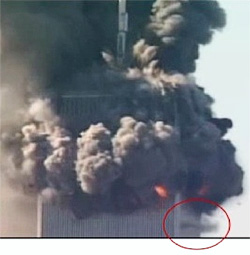
` When you watch the World Trade Center towers falling, you cannot see any squib-like explosions going off at all prior to the building's collapse; nor do all the sections of either building collapse simultaneously. What you see is this:

` The parts of the buildings that were above the plane impact points begin falling first - meanwhile, the lower parts of the buildings are completely stationary until the top has collapsed upon them, subsequently causing supports and other structures on the floors below them to bend and burst like bubbles, blowing debris out the sides. [You can see for yourself in the PBS NOVA Documentary Why The Towers Fell.]
` In other words, the plumes of debris seen in the videos cannot be from squibs as they do not actually begin until after the buildings have begun to fall! They also do not move in any particular pattern other than what would be expected as a reaction to the building coming down. If they were controlled explosions, of course, they would have to go off before the collapse in order to cause it.

` Timing is everything in dealing with cause-and-effect!

` Instead, such plumes are clearly due to all of the immense pressure from the millions of tons of tower bending and popping, which is enough catapult chunks of concrete out of the windows!
` I could also add that, though conspiracy theorists claim the towers were at near-free-fall speed, the showers of debris fell a lot faster than the buildings themselves.
` Again, controlled demolitions do not collapse like this, though it is precisely what you could expect from such buildings that had been hit by airliners and went up in flames.
` Yes, one could argue that the buildings could be rigged to fall from above the impact points first, but it would be extremely difficult to predict beforehand just where the impact points would be!

` I probably should also note allegations that the towers were demolished via explosions going from the top down. This isn't really a good way to demolish a building, because it may explode or topple (especially with a plane embedded in it) more than it implodes.
` That's why demolitions teams only demolish buildings by removing the support from under each floor so it can fall straight down ('pancake'). In other words, the charges must be set in order from the bottom floor and move upwards.
` Buildings can 'pancake' from other causes, though, such as having enormous, growing weak spots - and having a hollow center doesn't hurt, either. This is consistent with the appearance that the partly intact tops of the buildings tired out the weak spots, starting a chain reaction that effectively blasted and crushed the parts below them.
` On further observations, looking at the South Tower (Building 2), you can clearly see that it did not fall straight down - as the North Tower had done - but indeed, the tower tilted toward the impact point and began 'pancaking' downward at an angle.
` This makes sense because the North Tower (Building 1) was hit between the 94th and 98th floors, the plane tearing through to the center of the building. The South Tower was then struck between the 78th and 84th floors, at an angle, which severely damaged the entire northeast corner. [2005. "9/11: Debunking the Myths." Popular Mechanics. March, 2005.]

` Therefore, when you compare the two towers, the South Tower sustained damage that was both lower down and less evenly distributed. The weakened point, therefore, had to support considerably more weight, which is why one could predict that it would be tilted and that it would have collapsed before the the other tower despite being struck afterward.
` Not surprisingly this is exactly what had happened.
` (I could also mention that the North Tower had four centimeters of fire insulation while the South Tower only had two, which couldn't have helped.)
` But what do the conspiracy theorists make of this? Well, since the South Tower was struck second but fell first, that is counterintuitive - that means that something weird must be going on!

` Addendum: Some have asserted to me that the firefighters on the scene insisted that there were bomb explosions, and that these were seen by people before and during the towers' collapse. This may be so; however, the firefighters who reported these explosions think they come from loud air pops from collapsing floors, fire hitting the jet fuel, and electrical panels or generators (of which there were a few in the WTC buildings).
` These types of explosions are seen in other fires, and they can resemble bomb explosions. But would that compel a conspiracy theorist to say that similar-looking explosions in other office building fires were caused by bombs as well?
` When quoting the firefighters, I might add, the conspiracy theorists have deleted just what it was that the firefighters thought the sounds were from, leaving their 'it was like a bomb' descriptions.

The Other Tower


` Of course, WTC building 7 also collapsed because, as it is often claimed by conspiracy theorists, there were other bombs there!
` On the website wtc7.net, one can see a typical claim: "fires were observed in Building 7 prior to its collapse, but they were isolated in small parts of the building, and were puny by comparison to other building fires."
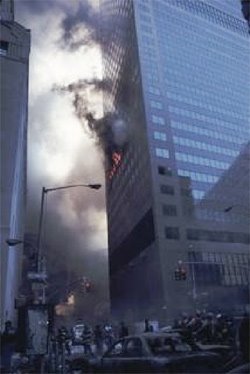
` Revealingly, their one-sided argument seems to be intimately linked with their literally one-sided images of Building Seven! They only use the north-facing views, such as this one, note the smoke pouring up and out of the far (and non-visible) south side of the building.
` Most interestingly, I was amused to see this same photo on a conspiracy theorist website with a caption claiming that it was a view from the south!

` That's literally backwards!

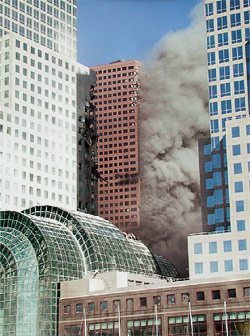
` In fact, the only way that it could appear that this building was not extensively damaged would be if one did not see the south side (actual photo below - note, the sun is shining on this side of the building, which makes sense because this is the Northern Hemisphere).
` As is plain, the building was in fact missing the smoke-pouring side and was otherwise extensively ravaged by fire from top to bottom.
` Richard Banaciski, a firefighter who was working at the site, reports this very thing:
We were told to go to Greenwich and Vesey and see what's going on. So we go there and on the north and east side of 7 it didn't look like there was any damage at all, but then you looked on the south side of 7 there had to be a hole 20 stories tall in the building, with fire on several floors. ["World Trade Center Task Force Interview: Richard Banaciski ." Interview conducted on December 6, 2001. Transcribed by Elisabeth F. Nason.]
` Does that look 'puny' to you? (Here's an even more revealing picture.) It should also be mentioned that the emergency response workers who were there noted that the lower south section of WTC7 looked as if it might collapse by 3pm - almost two and a half hours before it did collapse. [" World Trade Center Task Force Interview: Richard Banaciski ." Interview conducted on December 6, 2001. Transcribed by Elisabeth F. Nason.]
` In other words, their assessment was that the building was doomed, and doomed even sooner than it was in real life.

` Also, the authors of the aforementioned web site claim that in order to cause the pancaking of this building, that the falling debris would need to be symmetrical from both WTC1 and WTC2.
` Looking at actual footage, one can clearly see that the south wall of the building gave in first - it did not fall straight down! - which makes sense because that was the side that was burning and crumbling in.
` Like the south tower, the way the building fell was consistent with what we know about it and damage done to it by flying objects - in this case, debris that was catapulted from a building which had fallen down and slightly to the side. There are no real mysteries here - it collapsed in the path of least resistance!

` If one were to add on a planned demolition hypothesis, then how could one explain why the collapse began where the damage was most extensive? Did the conspirators know exactly where the debris would strike WTC 7?
` Indeed, the tower did not fall ' straight down into a convenient pile ' as alleged by creators of the documentary Loose Change. The rubble was 12 stories high, 150 meters across, and blocked!
` And what about the other buildings, the ones that remained standing long afterward? Were they laced with explosives just in case they were hit by debris as well?

` For further evidence to fuel the conspiracy, adherents are usually quick to mention that in a September 2002 PBS documentary called America Rebuilds, Larry Silverstein says:
I remember getting a call from the, er, fire department commander, telling me that they were not sure they were gonna be able to contain the fire, and I said, "We've had such terrible loss of life, maybe the smartest thing to do is pull it." And they made that decision to pull and we watched the building collapse. ["America Rebuilds " PBS Home Video, ISBN 0-7806-4006-3.]
` The conspiracy theorists - such as Alex Jones at prisonplanet.com - will tell you that this is damning evidence of a confession that he gave the okay to detonate the building, because they assume that 'pull it' means to demolish the building.
` And why? To get insurance money - despite the fact that he lost billions of dollars!
` Apart from Jones, I have also been sent a clip from the documentary by an anonymous proponent that includes the demolition team shouting "pull" just before WTC 7 collapses, along with the comment that this proves the word pull means to detonate a controlled explosion.

` What's going on here?

` It turns out that these are two completely separate uses of the word 'pull' - one by firefighters and one by demolitions teams.

` First of all, let's look at the demolition team video: I took a few minutes to watch this segment of the documentary; first of all, Luis Menendez from the Department of Design and Construction describes how concerned he is about where the damaged Building 6 will fall. We also hear a man with a distinctive voice shouting; "We're about to pull building six!"
` This is where the conspiracy theorists' video cuts off. Crucially, about thirty seconds after this part, the man with the distinctive voice is then shown describing how they are attaching cables to Building 6 and are planning to pull it down with heavy machinery!
` This, they do - completely shattering the conspiracy accusation!
` But, as the conspiracy theorists have learned; if you only show part of the documentary that 'proves' your point, and not the one that completely disproves it, not many of your followers will question your evidence.

` Could the term 'pull it' also mean an explosion? According to this article, from the point of view of a demolitions expert:
'We have never, ever heard the term "pull it" being used to refer to explosive demolition of a building, and neither has any blast team we've spoken with. The term is used in conventional demolition circles, to describe the specific activity of attaching long cables to a pre-weakened building and maneuvering heavy equipment (excavators, bulldozers. etc.) to "pull" the frame of the structure onto its side for further dismantlement.'
` One might also ask; what about when firefighters say 'pull it'? As in the military, 'pulling it' refers to giving up and pulling out your group. Soldiers are 'pulled' as well as firefighters. (In fact, I was amused to see that the term is used to refer to men in footage used in the conspiracy documentary Loose Change.) So, if firefighters are being pulled, it's because they are expected to be crushed by the collapsing, burning building.
` For an example of the term, another first responder said that there were "tremendous, tremendous fires going on. Finally they pulled us out." ["World Trade Center Task Force Interview: Richard Banaciski." Interview conducted on December 6, 2001. Transcribed by Elisabeth F. Nason.]
` So yes, it appears that Jones is taking this way out of context. On top of this, to clarify what Silverstein had meant, spokesperson Mr. Dara McQuillan said on September 9, 2005:
In the afternoon of September 11, Mr. Silverstein spoke to the Fire Department Commander on site at Seven World Trade Center. The Commander told Mr. Silverstein that there were several firefighters in the building working to contain the fires. Mr. Silverstein expressed his view that the most important thing was to protect the safety of those firefighters, including, if necessary, to have them withdraw from the building.

Later in the day, the Fire Commander ordered his firefighters out of the building and at 5:20 p.m. the building collapsed. No lives were lost at Seven World Trade Center on September 11, 2001.

As noted above, when Mr. Silverstein was recounting these events for a television documentary he stated, "I said, you know, we've had such terrible loss of life. Maybe the smartest thing to do is to pull it." Mr. McQuillan has stated that by "it," Mr. Silverstein meant the contingent of firefighters remaining in the building. [See " 9/11 Revealed? A New Book Repeats False Conspiracy Theories."]
` The 'story' that there had been many firefighters evacuating the tenants in the building, and that they worked there until shortly before the collapse occurred, is backed up in abundance. For another example, Daniel Nigrois said in a NYT interview:
The most important operational decision to be made that afternoon was [that] the collapse [of the WTC towers] had damaged 7 World Trade Center … It had very heavy fire on many floors and I ordered the evacuation of an area sufficient around to protect our members, so we had to give up some rescue operations that were going on at the time and back the people away far enough so that if 7 World Trade did collapse, we [wouldn't] lose any more people. We continued to operate on what we could from that distance and approximately an hour and a half after that order was [given], at 5:30 in the afternoon, World Trade Center collapsed completely. ["World Trade Center Task Force Interview: Daniel Nigrois ." Interview conducted on October 24, 2001.]
` Indeed, there is large agreement between McQuillan's response and the testimony of the firefighters, including facts such as firefighters being at the WTC 7 site, rescuing and evacuating people until late in the afternoon, that they predicted that collapse was imminent, and that they acted on this by pulling back and waiting for the building collapse at around 5:20 pm.

` If you are a conspiracy theorist, however, you might just ignore this because you are convinced that you are correct, and that maybe even if this is an accurate counterargument, possibly, it doesn't stop all the other evidence from being true.
` Right, like the melting steel and the 'puny' fires in Building 7.

` When I look at the Truth Movement's story about WTC 7, I find that it is full of gaping holes, much like the ones found on the buildings themselves, and so inevitably cannot stand up to scrutiny.
` Larry Silverstein could not have destroyed the WTC building for all of those reasons - plus the fact that his alleged confession was on a PBS special and therefore seen by millions seems a bit weird.
` Furthermore, he does not have any link with the U.S. government (besides being a landlord of government agencies), which are supposedly the real terrorists.

` What I'd like to see those conspiracy theorists explain is that if buildings 1 and 2 both needed to throw debris out to hit WTC 7, and then all three buildings need to be wired for demolition in order to collapse, why bother? Why not just blow the buildings up with bombs and then blame terrorists? (It's been done before.) Why would they need planes?
` On top of that, prepping a building for demolition takes a considerable amount of time - first, it needs to be partly gutted, and then extensively wired! And those were huge, 110 buildings, so that would take... what?
` The Landmark Building collapse - which is compared to the WTC collapses by conspiracy theorists - took four months just to wire up, and that was only thirty stories. So, probably over a year.
` So how could they Especially with all those people working there!
` How could nobody notice that? Or were they in on the secret? Maybe they're really still alive? It depends on which conspiracy theorist you ask. In any case, the baseless assumptions are wearying.

The Pentagon


` Many of the 9/11 conspiracy theorists also believe that the Pentagon was not struck by Flight 77 but a strategically-fired missile or even a bomb.
` Thierry Meyssan wrote in his book Pentagate, that the damage done to the Pentagon was too limited to have resulted from the crash of a Boeing 757. Loose Change claims that the damage was "a single hole, no more than 16 feet in diameter," totally without remains of an airplane.

` Such only appears this way from photos taken at certain angles.

` The 9/11 conspiracy theorists selectively use pictures taken at such a perspective that shows that the damage to the Pentagon looks small, and try to ignore pictures that show - more accurately - the full extent of the damage.
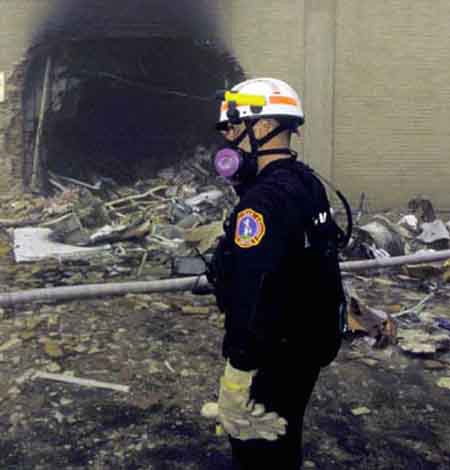
` And what do we see? There is indeed a large, gaping hole in the side of the Pentagon - larger in photos that haven't been cropped by conspiracy theorists. This is expected for the damage done by a high-speed fixed-wing aircraft smashing into nine feet of reinforced concrete. While the plane could slam through the wall, the wings would shear off like aluminum foil.
` (Interestingly, there are several photos of a smaller round hole in the side of a wall, said to be the outside wall by at least some conspiracy theorists. However, this wall is one of the fortress-like layers inside the building, and the 'official story' holds that the hole was made by the landing gear - a total misrepresentation of the data once again.)
` Aircraft wings are extremely delicate, one should note, and can only leave noticeable imprints in buildings that are softer than the Pentagon, especially if they have a lot of glass on the outside (like WTC 1 and 2). The only place an airplane can smash through nine feet of reinforced concrete and leave wing-prints is in the cartoons.
` Yet, this point is exactly what conspiracy theorists push as being evidence that it wasn't a plane. That's right; though wing-prints aren't realistic in this case, the fact that they aren't found is suddenly... well... suspicious!

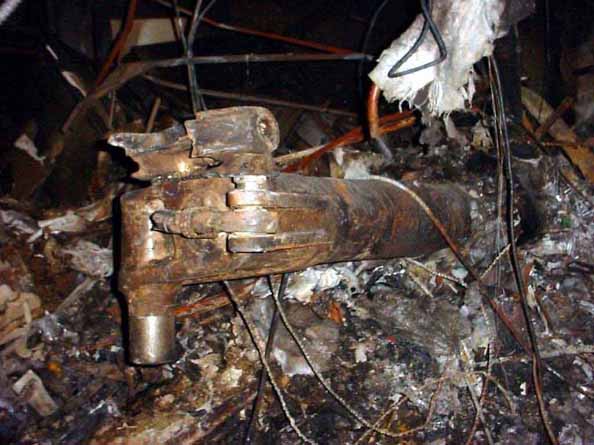
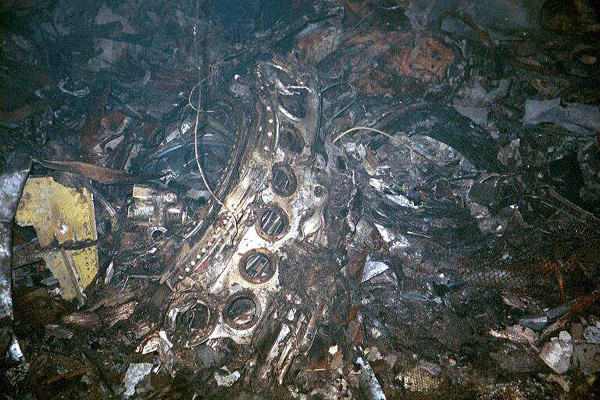
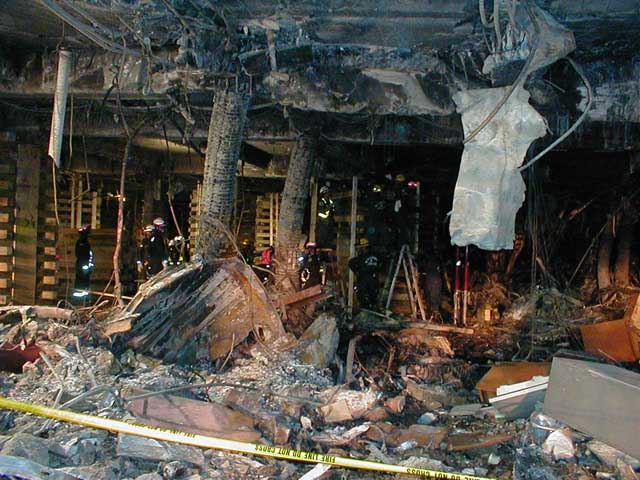
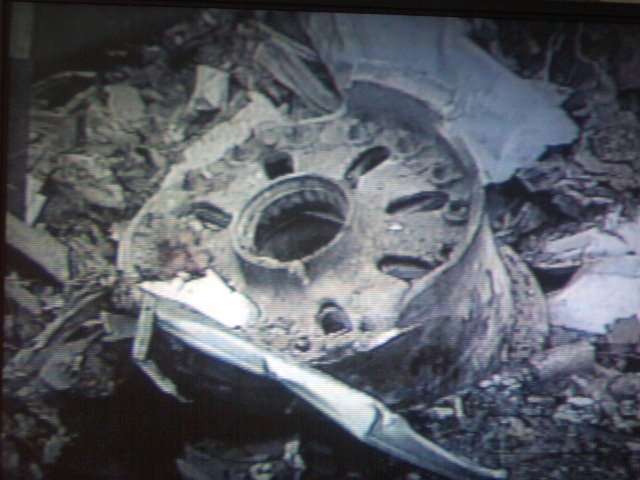
` As for the alleged absence of airplane parts, numerous photos show that there are parts of an airplane in the wreckage! Parts that have clearly been fragmented and charred by plowing through nine feet of reinforced concrete at four hundred miles per hour or so. Their condition is fairly typical of plane wrecks in which the plane has hit a very solid object.
` For example, you can see the landing gear, the engine, curved chunks of fuselage - even a wheel hub, which is indeed among the wreckage (to the right of the man). Here is a piece of the wreckage strewn on the lawn - that is no missile!

` Said conspiracy theorists generally write these off as 'planted' plane wreckage or faked photos. And they will ignore anyone's eyewitness accounts such as the one from blast expert Allyn E. Kilsheimer, who was the first structural engineer at the crash site.
` He describes (in an article in Popular Mechanics) what he himself observed:

I saw the marks of the plane wing on the face of the building. I picked up parts of the plane with the airline markings on them. I held in my hand the tail section of the plane, and I found the black box....

...I held parts of uniforms from crew members in my hands, including body parts. Okay?" [" 9/11: Debunking the Myths." Popular Mechanics. March, 2005.]

` Accounts such as these are not important for conspiracy proponents to consider since, because most of them disagree with the conspiracy point of view, they must be fictional.

` Another thing proponents claim is that CNN correspondent Jamie McIntyre told Judy Woodruff that he couldn't see anything of a plane crash. When one believer informed me of this for the first time, I admit I was baffled and didn't know how to explain it.
` I later found that the answer is clear when you look at the transcript:

WOODRUFF: Jamie, Aaron was talking earlier — or one of our correspondence [?correspondants] was talking earlier — I think — actually, it was Bob Franken — with an eyewitness who said it appeared that that Boeing 757, the American jet, American Airline jet, landed short of the Pentagon.

Can you give us any better idea of how much of the plane actually impacted the building?

MCINTYRE: You know, it might have appeared that way, but from my close-up inspection, there's no evidence of a plane having crashed anywhere near the Pentagon. The only site is the actual site [?side] of the building that's crashed in, and as I said, the only pieces left that you can see are small enough that you can pick up in your hand. There are no large tail sections, wing sections, fuselage, nothing like that anywhere around, which would indicate that the entire plane crashed into the side of the Pentagon and then caused the side to collapse. [Transcript.]

` Clearly he is explaining that the plane made it inside of the Pentagon, rather than crashing beside the Pentagon! On the other hand, there is an ambiguous sentence: "From my close-up inspection, there's no evidence of a plane having crashed anywhere near the Pentagon."
` If you take away the context, you can twist that sentence to mean that there was no plane debris anywhere, as opposed to the fact that he could not see evidence of the plane touching down 'anywhere outside of but nearby the Pentagon'.
` This is exactly the line my conspiracy theory-believing friend had been fed. As one can plainly see, it is a ridiculous and intentional misrepresentation of what really was said.

` Though I could write far more on the subject, I think it's time I gave it a rest. Part 2 of this post will deal with parts of the conspiracy theory that do not involve planes crashing into buildings.


Read more!

Friday, July 27, 2007

Accepting the Unexpected


` In science, as in life, you have to be prepared to accept what you don't expect, or even think is possible. You never know what you're going to find - thus is the importance of keeping an open mind.
` Sometimes people are even forced to accept what they least expect, as in the case of a friend of mine:

` One night, she was awoken by a plaintive meowing from outside her bedroom window.
` 'Oh, the cat wants in', she thought. So, she got moving in the direction of the window - only to be stopped in her tracks.

` A giraffe's head was peering in from the roof!

` Needless to say, we don't expect to see giraffe heads where we think our cats should be.
` In this case, her cat had gotten hold of a giraffe mask and was carrying it dutifully to his human family, just as he had with assorted toys, leaves, pieces of cardboard and numerous gloves.

` In science, of course, surprises are to be expected and any personal preconceptions are to be criticized if they don't seem to match reality. As they say, there are no 'sacred cows' allowed!
` This is what allows scientific hypotheses (and occasionally full-blown theories) to change as more information is discovered. Mistakes, therefore, can be corrected. After all, part of a scientist's training is learning that that they don't know THE truth - they only know what is likely to be the truth, with the information they have at the time.

` That's why the misconception about the portacaval shunt (which I wrote of in this post) is no isolated incident: Scientists are quite often wrong about things, which is the reason for their peers to both review studies (challenge them with their knowledge) and repeat them (challenge them in 'real life') - there is always a chance that the results were due to an explanation that has been overlooked.
` After all, the first priority of the scientist (and the science-minded person) is to keep up with reality, regardless of what they may personally believe. The knowledge derived from the scientific method is ever-evolving.

` If I may use a quote-within-a-quote from Adam Zeman's Consciousness; a user's guide:

In the first place scientific knowledge is always provisional: it is uncertain which beliefs will stand and which will fall during the constant process of revision. As the Oxford physician Sir William Osler warned a group of newly qualified doctors at the turn of the century: 'Gentlemen, I must tell you that half of what you have been taught is wrong, and we don't know which half.'
` So true! It is easy to be wrong, largely because it is easy enough not to see alternative explanations. One famous and easy-to-grasp example is the horse named Kluge ("Clever") Hans.
` A hundred years ago, a German schoolteacher presented a horse that appeared to have learned reading, spelling and arithmetic! Notably, every time Hans was presented with a math problem (either verbally or written), he would tap his hoof a number of times.
` Eighty-six percent of those times it was the correct answer. Clearly, this could not be explained by chance!
` Enter the psychologist Oskar Pfungst. He determined that yes, it was not a trick; Clever Hans' trainer was not perpetuating a hoax. Indeed, Clever Hans could get the correct answer even when the trainer was not around!

` One might expect that since the horse really could get the answer right, and that it had nothing to do with signaling from his trainer, then he must really understand math problems! This is the proposed explanation (or hypothesis) held by a lot of people of that time.

` But what about a less obvious possibility?

` Pfungst also found that when the person asking Hans a question did not know the answer, or if Hans could not see the questioner, he would continue tapping his hoof after the correct number had been reached.
` From this, Pfungst managed to work out what was going on; when someone asked the horse a question, they subconsciously leaned forward to a barely-perceptible degree. The horse then tapped his hoof until the correct number was reached, upon which the questioner leaned back, cuing the horse to stop.
` Even when made aware of it, Pfungst still couldn't stop himself from leaning slightly - apparently it is too great a reflex!

` In that way, our intuition can lead us into believing in the strangest and most wonderful ideas, even when they aren't true. While human intuition is useful, it is also what makes a magician's illusions seem so mystifying!

` Similarly, just as Hans' ability to answer correctly could not be separated from his being able to see people who knew the answer, experiments involving alleged psychics show very much the same type of thing.
` For example, people who say they can psychically 'read' someone must be able to see or hear the person - or even someone who is familiar with them; already know something about the person themselves; or at the very least, make extremely vague statements lest they wind up miles away from the mark!
` In fact, you can even deliberately mislead these people by reinforcing any kind of nonsense that you tell them, or that they guess, about your life! However, I think I'll save the details of conscious - and even subconscious - cold reading for another day.

` What really gets me is that subtle cues (as well as obvious ones) are not only used by horses and charlatans; they can easily fool the ordinary person into believing that they have psychic abilities themselves!
` In fact, this very same thing was constantly happening with myself as a teenager. Much of it had to do with avoiding my sadistic and mentally ill father, who would unpredictably and severely punish me on a whim. This was one of many reasons I could generally be found as a wide-eyed, twisted heap of taut muscles and tendons, collecting cobwebs in a corner or scuttling out of sight.
` Needless to say, avoiding him at all costs was imperative. So, I developed the amazing ability of predicting that he was about to head towards whatever room I was in. I didn't know how I did it, but somehow I learned that whenever I would feel a deep panic and start sweating, that meant I had thirty seconds to either get away or look half-dead so he wouldn't bother me.

` This is why I suspect that I was subconsciously hearing some kind of cue in his footsteps - even when I was unaware of hearing anything at all - which, by association with his approach, filled me with terror. Puzzlingly to me at the time, this often happened when I could hear that he was standing relatively still. I can guess that it probably had something to do with the way he shifted his weight.
` Since I couldn't explain where my 'gut feelings' were coming from, I figured that they were some kind of psychic ability. So, I read a lot of library books on the subject and found that I could relate to the people who wrote about their experiences. Not only that, but I 'discovered' that I had a few more 'psychic abilities' as well!
` So, for a while I was a firm believer in these things, heedless to anyone's logical arguments, until I properly learned about the scientific method and fully understood its emphasis on not jumping to conclusions.

` One of many examples of this is the 'staring' experiments by Rupert Sheldrake, who declared that the feeling of 'being watched' by a hidden observer is a psychic ability. Indeed, his results showed that participants had a lot more than a 50% chance of guessing whether or not someone out of view was looking at them.
` This would be amazing if his testing sequences were also random, thus giving his subjects a 50-50 chance of being correct. In actuality, there are noticeable patterns in the sequences he used: A lot more alternations (A, B, A, B, A, B) can be found in his sequences compared to other possibilities (A, A, A, B, A, A) which would normally occur in equal proportions in a truly random sequence.
` Such were the findings of Colwell, Schroeder and Sladen (2000): To see just how much these testing sequences had to do with Sheldrake's results, they did a couple of experiments to see if they could separate the sequences from positive results.

` Here's what they did:

` In the first experiment, they had seven men and five women (all believers in the 'staring effect') in a room by themselves where they sat with a one-way mirror to their backs. Meanwhile, someone else was behind the mirror, staring at them, or not, according to Sheldrake's sequences of 'staring' and 'not-staring'.
` Each participant was given buttons to press for indicating whether or not they felt like they were being stared at. For the first sixty trials of this experiment, they were given no feedback whatsoever as to whether or not their responses were correct.
` For the rest of the trials - 180 more of them - they were shown the words 'correct' or 'false', depending on their success at guessing.

` In the sixty no-feedback trials, everything went as predicted - the average guess fell almost exactly on the mean chance expectation. However, in the trials with feedback, they quickly became more and more accurate, until their guesses were far above chance!
` Why? Since Sheldrake's sequences were not random, the participants could use the feedback - if subconsciously - to catch onto the fact that there are a lot more alternations in the sequence than chance would allow.
` Put another way, the participants learned to switch their guesses most often to 'not-staring', after being told that the previous trial had been 'staring', and vice-versa (even if they had not guessed the previous trial correctly).

` Of course, a believer in Sheldrake's hypothesis could easily say that the real (and least simple) explanation for the improvement is simply because the subjects became more sensitive to their psychic ability.
` Fair enough.
` So, in their second experiment, the researchers took some random sequences of their own, analyzed them to make sure they were really random, and then tried those out on the same participants.
` Plus, to make it as easy as possible for them to use their 'psychic abilities', the subjects knew if they had guessed correctly or not in all of the trials! But, with no pattern to learn, they were unable to do better than chance. Their alleged ability 'disappeared!'

` So there you have it - apparently Sheldrake's non-random sequence is what had influenced the outcome of his 'staring' experiments. In other words, his hypothesis has been falsified.
` And yet, Sheldrake continues to believe in his results and encourages other people to download his skewed testing sequences from his website in order to prove that they, too, have the same ability! Sure enough, that seems to be what they really do find, and you can too - unless, perhaps, you flip a coin instead!

` Naturally, a very real feeling of 'being watched' does exist, even when you don't see the watcher. If I had to guess, part of this probably has to do with the fact that for thousands of years, human beings have been both predators and prey - even towards each other. And, as with my own 'dad-alert' ability, it probably has to do with hearing, because an animal suddenly tries to be stealthy when it becomes aware of a human.
` But is the animal being stealthy in order to hide, or stealthy in order to strike? Either way, sensing this is to your advantage!
` It's a reasonable hypothesis, sure. But to explain the feeling of being watched also as a psychic ability? Even cases where it seems to be true are, well, not what they seem.

` Such revelations are the consequences of having a curious and open mind. After all, you never know what you're going to discover. Especially back when there seemed to be inexhaustable amounts of discovering being done all the time!
` When British explorer Harry Johnston set out into the jungles of the Congo to find a striped animal once nicknamed the 'African unicorn', he suspected it was some type of zebra.
` As governor of Uganda, he rescued some Wambutti pygmies from a German showman, who intended to display them in Europe. On the way back to their jungle home, the grateful pygmies told Johnston about the animal he sought, and even showed him its hoof-prints!
` But these were not zebra tracks; they were cloven! So, Johnston changed his mind about what was going on, and instead suspected it was a type of eland. But when the pygmies were able to show him some remains, he found that it was neither zebra nor antelope; it was closely related to giraffes!
` In his honor, this sacred animal of the pygmies, which they called o'api, was scientifically named Okapia johnstoni.

` I guess one could say; sacred cows (or zebras) aren't allowed if they are sacred okapis. Oh, stop groaning!

` Unfortunately, while people are not usually afraid of finding new species, astronomical objects, or genes, they often are afraid to discover new ways that they have been deceived. They don't want their preconceptions to be dashed.
` Is it any surprise that these people are the ones who have told me that I am too ignorant to understand that the scientific method and the logic that goes with it (generally referred to as modern skepticism) is not a problem-solving tool at all? Science has very little to offer, they say, because it is just another dogmatic religion.
` Dogmatic religion? Ultimately bowing down to reality, rather than someone's rigid, preconceived framework, is what science is all about! But no, they say, I am the one who has been deceived; I am the know-it-all whose faith in science is so blind that I cannot see how narrow my mind has been made!

` To be fair, I used to take this view myself saying the same harsh words towards scientists and skeptics. How dare they say that psychic powers are an illusion? I had them! Or ghosts? I'd seen one! Or alien abductions? Well, about the alien abductions; by the time I'd had my second one I was fairly certain they were illusions.
` Though being paralyzed and floating through my window into the mothership seemed real enough, I managed to take control, turning the aliens purple! I started laughing, and then I noticed that I was 'suddenly' still in bed!
` Those experiences, by the way, were my second and third episodes of sleep paralysis - and I've had others of various different types since then. (I will certainly have to write about these some time!)

` It is for the people who think they cannot be fooled that I once wrote a little story:

` Grig and Danald are two stone-age pioneers, still discovering a strange new continent. They are among the first people ever to set foot in this place, and are trying to determine the identity of a mysterious scavenger.
` It seems that every time they carry off the first load of a Pleistocene-sized kill to their tiny settlement, the carcass has been completely stripped by the time they get back!
` They know that the carnivorous marsupials they have encountered could not be the culprits, as the tracks left around the carcass are not paw-prints: Instead, they look like they were left by the dragging gait of a large reptile.

` One day, Grig and Danald brought down quite a large wombat-like animal (Diprotodon to you and me), and have smoked and packed up much of the meat. It is then that the topic of the mysterious scavenger came up.
` Grig volunteered a hypothesis; "You know, I think that those tracks were left by some sort of crocodile."
` "But we're not even near any large-enough watering hole," said Danald. "Don't crocodiles usually stay around water almost all the time?"
` "That's true," said Grig. "But these tracks are very similar - you can even see the tail! Maybe it's just a different kind of crocodile." He looked around nervously and picked up his pack. "In that case, we'd better leave!"
` "Well, you know what I think, Grig?" Danald said, picking up his own pack. "The reason we never see this thing is because it's not a living animal at all; it's the wandering spirit of a lonely and hungry crocodile that was shunned by its brothers and sisters. That's why it doesn't have to be around water."
` "That doesn't make much sense," said Grig. "Everyone knows that spirit crocodiles can't leave tracks, nor do they drag unsuspecting animals under the water to eat them. They live in a whole different world we can't usually see! I say, it's a big animal with sharp teeth, whatever it is!"
` "Maybe spirit crocodiles can't hunt animals," said Danald, "but what if they can eat something that's already been killed?"
` "Danald," Grig sighed, "to say the least, I think a council with the shaman is in order."
` "Good! Then maybe he will prove me right!"
` Hearing a noise behind him, Grig turned to see that they were being monitored by dark eyes and a long, flicking tongue.
` Alas, both of the hunters' hypotheses had just been dashed to bits upon their discovery of the half-ton monitor lizard, Megalania prisca.
` "What the..." Danald gasped and looked around for Grig.
` But he was already running for his life.

` Award-winning it's not, but the moral is; without objectivity, you could wind up getting bit on the... well, in this case, possibly several areas at once!


Read more!